


Interpretation ID: 49 CFR 571.3 Letter of Interpretation to Reinhardt
May 6, 2026
U.S.Department of Transportation
National Highway Traffic Safety Administration
Office of the Chief Counsel
1200 New Jersey Avenue SE.
Washington, DC 20590
Peter Reinhardt Chairman, Revoy
440 N Barranca Ave #4986
Covina, CA 91723
Dear Mr. Reinhardt,
I write in response to your letter and information submitted to my staff, received on June 25, 2025, and October 17, 2025, respectively, requesting an interpretation on the proper vehicle classification of your product for certification and compliance under 49 CFR Parts 567 and 571, and for assigning a vehicle identification number (VIN) under 49 CFR Part 565. NHTSA concurs with your belief that the product (the "Revoy") may be properly classified as a "trailer converter dolly" for the purposes of FMVSS compliance and certification under 49 CFR Parts 567 and 571, and as a "trailer" for the purpose of assigning a VIN under 49 CFR Part 565.
This interpretation letter does not have the force and effect of law and is not meant to bind the public in any way. This letter is only intended to provide clarity regarding existing requirements under the law at the time of signature. This letter is based on our understanding of the facts as stated in your letter and in communications with NHTSA.
Background
NHTSA is authorized by the National Traffic and Motor Vehicle Safety Act (Safety Act, 49 U.S.C. Chapter 301) to issue Federal motor vehicle safety standards (FMVSS) setting performance requirements for new motor vehicles and new items of motor vehicle equipment. The Safety Act requires manufacturers to self-certify that their vehicles and equipment conform to all applicable FMVSS in effect on the date of manufacture.
Below is an image of the Revoy that you provided, for reference.
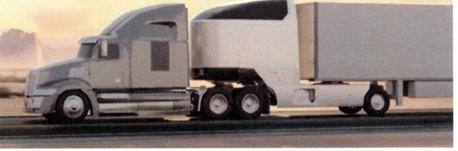
In your materials, you described the Revoy as stated in this paragraph. It is a wheeled platform that attaches to a semi-truck tractor via a kingpin connection and to a trailer via a fifth wheel connection. It contains a battery pack as well as a powered axle, through which it provides motive power and reduces the fuel consumed by the truck tractor when hauling. The Revoy can operate independently of a truck tractor under 5 mph for hitching purposes via remote control but is not intended to be so operated on public roads. On occasion, it may be drawn by a truck tractor without an accompanying trailer (towed singly). It is equipped with air brakes and an antilock braking system (ABS) controller and has a GVWR greater than 10,000 pounds. Brake testing you conducted demonstrated that when the Revay is towed singly there is no negative effect on stopping distance or traction control systems.
Discussion
Vehicle Classification
The Revoy is a motor vehicle, and therefore must be permanently affixed with a label that states its type classification as defined in 49 CFR 571.3 and which states its conformance to the applicable FMVSS. 49 CFR 567.4(g)(7).
I first address the proper classification of the Revoy under section 571.3 and Part 567. Based on our analysis of the type classifications defined in § 571.3(b), NHTSA agrees that your product appears to be a "trailer converter dolly." In 49 CFR 571.3(b):
Trailer converter dolly means a trailer chassis equipped with one or more axles, a lower half of a fifth wheel and a drawbar.
Drawbar is not a defined term in the regulation. The Revoy has a trailer chassis, an axle, and at its rear the lower half of a fifth wheel connection for attachment to a semi-trailer's kingpin. At the front, the Revoy attaches to the towing vehicle by way of a kingpin connection on a gooseneck that connects to the lower half of a fifth wheel on a truck tractor. Although the Revoy lacks the traditional drawbar design used on conventional trailer converter dollies, for purposes of applying section 571.3 in these circumstances NHTSA would consider the combination of the gooseneck and a kingpin to be a rigid coupling device within the scope of the term "drawbar." This aligns with how NHTSA has historically viewed similarly constructed vehicles. For instance, in a letter of interpretation to Hyster in April 1973, NHTSA expressed its view that a device that had load transfer and kingpin but was similar in appearance and use to a converter dolly is classified as a trailer converter dolly for the purposes of determining conformance to the FMVSS.1 In addition, NHTSA has in the past described a trailer converter dolly as a motor vehicle designed to tow another vehicle rather than carry persons or property itself, which is consistent with your description of the Revoy.2
Application of Specific FMVSS
Regarding specific FMVSS, please be aware that this is not an exhaustive list of FMVSS which may or may not be applicable. Rather it addresses only the FMVSS you raised in your letter.
Your letter states your understanding, with which we agree, that your product (or equipment installed on your product) is subject to the following:
- FMVSS No. 106, Brake hoses.
- FMVSS No. 119, New pneumatic tires for motor vehicles with a GVWR of more than 4,536 kilograms (10,000 pounds), specialty tires, and tires for motorcycles.
- FMVSS No. 120, Tire selection and rims and motor home/recreation vehicle trailer load carrying capacity information for motor vehicles with a GVWR of more than 4,536 kilograms (10,000 pounds).
You have inquired about certain aspects of FMVSS Nos. 121,224, and 108. Our responses are listed below.
- FMVSS No. 121, Air brake systems. The Revoy is equipped with air brakes and therefore is subject to FMVSS No. 121. You are correct that the product is not subject to:
- S5.5.1 (limit on service brake actuation and release time during ABS malfunctions).
However, it is subject to S5.5.2 (antilock system power for trailers). - S5.6 (parking brakes), though meeting S5.6 is an option for complying with S5.8.1 (Emergency brakes for trailers; emergency braking capability).
- S5.5.1 (limit on service brake actuation and release time during ABS malfunctions).
- FMVSS No. 224, Rear impact protection. The Revoy does not need to comply with this standard regardless of its classification as a trailer converter dolly. This is because, based on your description that the rear tire is less than 305 mm from the rear of the vehicle, it appears it would be a "wheels back vehicle" under this standard.
- FMVSS No. 108, Lamps, reflective devices, and associated equipment. You are correct that the Revoy is not subject to this standard because trailer converter dollies are exempt under S3.1.3. However, you also referenced a letter from the Federal Motor Carrier Safety
1 Available at https://www.nhtsa.gov/interpretations/nht73- I 26.
2 Letter to Curtis Stiede on October 16, 1995, available at https://www.nhtsa.gov/interpretations/11064.
3 See also Letter to Truck Equipment & Body Distributors Association (March 21, 1972) available at, https://www.nhtsa.gov/interpretations/nht72-534.
Administration (FMCSA) which stated that your product is a "converter dolly" under 49 CFR 393.5, the definitions applicable to FMCSA regulations on parts and accessories necessary for safe operation. When your product is towed singly, FMCSA lighting regulations likely apply and require the lighting devices specified in, e.g., 49 CFR 393.11.
VIN Assignment
Regarding assigning the correct VIN, section 565.15 requires that the VIN identify the type of the motor vehicle. The term "type" is defined in section 565.12 as:
a class of vehicle distinguished by common traits, including design and purpose. Passenger cars, multipurpose passenger vehicles, trucks, buses, trailers, incomplete vehicles, low speed vehicles, and motorcycles are separate types.
In addition, section 565.12 states:
Unless otherwise indicated, all terms used in this part that are defined in 49 CFR 571.3 are used as defined in 49 CFR 571.3.
However, Part 565 does not contain a definition for, nor use the term, "trailer converter dolly." In light of that, you may assign a VIN to Revoy vehicles that code it as a "trailer." When you submit additional materials to NHTSA under Part 565 for the Revoy, they may contain specific information indicating that the body type of the trailer is a dolly. This is common practice and is also consistent with Part 579, Reporting of Information and Communications About Potential Defects, in which
§ 579.4 specifies "trailer" as a "type" and states that "trailer converter dolly" is a category of trailer.
As a manufacturer of a motor vehicle, you must also submit certain identifying information to NHTSA in accordance with 49 CFR Part 566, Manufacturer Identification. Finally, because your product is a motor vehicle subject to the requirements of the Safety Act, it is subject to recall obligations of notification and remedy in 49 U.S.C. 30118 through 30120. Other legal requirements applicable to motor vehicle manufacturers are addressed in NHTSA's New Manufacturers Handbook, available at https://vpic.nhtsa.dot.gov/ManufacturerHandbook.pdf. In addition, States may have laws applicable to certain motor vehicle lighting. I am unable to advise you on those laws, but you should ensure your product complies with any and all applicable State laws.
If you have any further questions, please contact Eli Wachtel of my staff at interpretations.NHTSA@dot.gov.
Sincerely,
Peter Simshauser Chief Counsel
Dated: 5/6/2026
Ref: 49 CFR Part 571.3