


Benefits
How an Impaired Driving Tracking System Works
An IDTS is a centralized data management system that collects information from data management systems of various agencies, such as law enforcement, courts and licensing agencies, to gather common information on impaired driving offenses. This system provides analytical tools for agencies to find areas for improvement and streamline processes by reducing opportunities for data redundancy and inconsistency. It also helps agencies create standards, such as necessary security restrictions and procedures. An IDTS not only helps the state track impaired driving offenders from arrest through completion of sanctions but also provides the state with improved data to accurately capture impaired driving trends. Example data elements an IDTS could provide include information on arrests, convictions, fines assessed and paid, pleas, sanctions, sentences, and treatment effectiveness.
An IDTS should include case management and statistical components. The case management component collects relevant and timely information about impaired driving offenders (from arrest through disposition), which leads to better sentencing. The statistical component reports on historical trends in impaired driving offenses based on the case management data and gathers trend data on impaired driving arrests, adjudication, sentencing and treatment outcomes for various demographic groups. The graphic below provides an example of the IDTS process, outlining the relevant agencies, data they share and specific points in the process when the data sharing occurs.
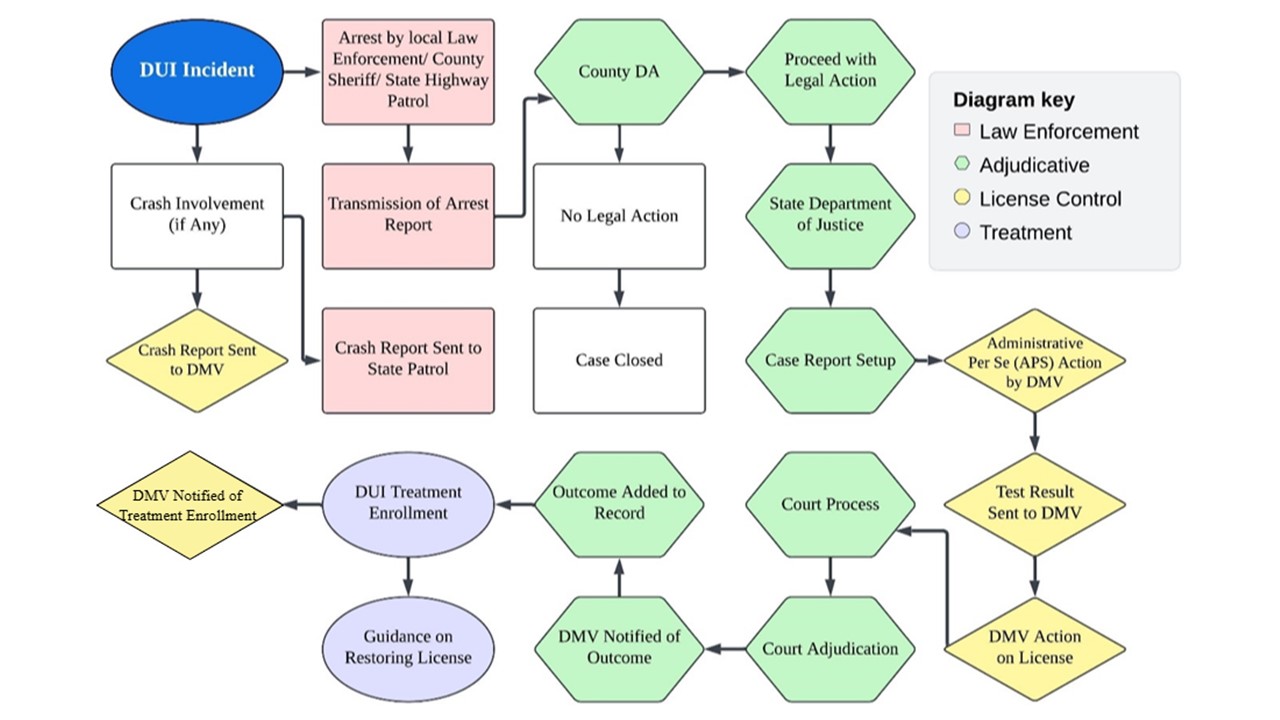
Example of an IDTS Process and Data Flow
Impaired Driving Tracking System Benefits
Many states lack an IDTS that links critical data elements across law enforcement, state driver’s licensing agencies and the courts. A comprehensive IDTS with shared information and data management between these primary sources is essential for finding repeat impaired driving offenders and larger impaired driving trends. This integration supports data-driven state investments aimed at reducing instances of impaired driving, ultimately saving lives and conserving finite state resources.
Below are ways states can benefit from developing an IDTS.
Prompt identification of offenders and appropriate administration of fines and penalties. By integrating arrest and adjudication data, the system ensures accurate case tracking, which can help to promptly identify offenders and inform the severity of charges and sentences to be administered. Specifically, the system provides benefits to law enforcement officers, prosecutors, judges and driver’s licensing agencies in several distinct ways:
- Enables law enforcement officers to quickly access a driver’s history of alcohol-related offenses, allowing them to make informed decisions during traffic stops or at the scene of an incident. An IDTS also supports law enforcement officers with electronic data collection and real-time record updates. This capability will reduce relying on manual data entry and decrease errors in tracking an offender’s history.
- Provides prosecutors and judges with correct, complete, and timely records, ensuring they have immediate access to prior offenses, sanctions, and treatment history. Access to these records allows prosecutors and judges to make informed sentencing decisions and better monitor compliance with previous legal requirements.
- Gives licensing agencies timely updates on sanctions, allowing them to accurately record violations on a driver’s record. Accurate and timely sanction records help law enforcement officers identify restricted drivers during traffic stops. This capability will ensure compliance and prevent individuals with suspended licenses from returning to the road prematurely. Additionally, data from ignition interlock devices can alert licensing agencies of violations and ensure appropriate actions are taken and recorded in a driver’s record.
- Helps states track individual charges and dispositions to ensure fines are paid and sanctions are completed. IDTSs can also ensure consistent enforcement of fines and penalties.
- Allows stakeholders to obtain information on impaired driving offenders at any point during the handling of criminal cases.
Findings from discussions with the states that participated in this project show an IDTS improves tracking of offenders for prompt identification and administration of penalties. The stakeholders from these states mentioned that the system facilitates integration of data from arrests, charges, court dispositions and sanctions, ensuring timely updates to driver records. These stakeholders believed prompt identification and integrated data help to keep up-to-date records, which is crucial for accurate case management.
Data validation and quality control. States with an IDTS conduct regular data reviews to confirm and address anomalies, inconsistencies and missing information. These careful data validation processes help ensure data accuracy and reliability, which are critical for meaningful analysis. This approach aligns with research, which further stresses the benefits of an IDTS for accurate case tracking and transparency in court dispositions. Specifically, the system improves accuracy in conviction rates by preventing the miscounting of amended charges and case dismissals.
Effective evaluation of countermeasures. Implementing an IDTS equips states with reliable, aggregated data to help them accurately test the impact of impaired driving countermeasures. By using an IDTS, policymakers can assess the effectiveness of impaired driving laws, measure the impact of enforcement strategies and intervention programs, and analyze geographic and demographic data. This data-driven approach also reduces administrative burdens, enhances efficiency, and enables stakeholders to identify and address recidivism. It also helps ensure that impaired driving policies and rehabilitation efforts are both effective and responsive to the current environment. Specifically, an IDTS:
- Provides states accurate and aggregate data to reduce impaired driving.
- Allows states to determine and gauge their impaired driving problem or measure if goals have been achieved by using the geographic and demographic information of impaired driving offenders. This information helps stakeholders, policy makers and treatment professionals evaluate the current impaired driving environment, countermeasure programs and laws designed to reduce impaired driving or rehabilitate impaired driving offenders.
- Provides ways for states to track recidivism data on jail sentencing, license restriction and license suspension of impaired driving offenders. The data also quickly identifies, in turn, is submitted to the FBI and then additionally helps identify repeat offenders at a nationwide level.
Annually, states allocate millions of dollars to combat impaired driving through education, rehabilitation programs, law enforcement and the judicial system. An IDTS enhances these efforts by streamlining processes, improving decision-making and identifying the most effective countermeasures. Investing in an IDTS not only improves operational efficiency but also strengthens the states’ ability to mitigate the impacts of impaired driving and increase public safety.
By providing accurate, real-time data, an IDTS helps states strategically allocate resources to initiatives that yield the greatest reductions in alcohol-impaired driving.