


Pathways to Safer Streets
A National Traffic Safety Action Plan
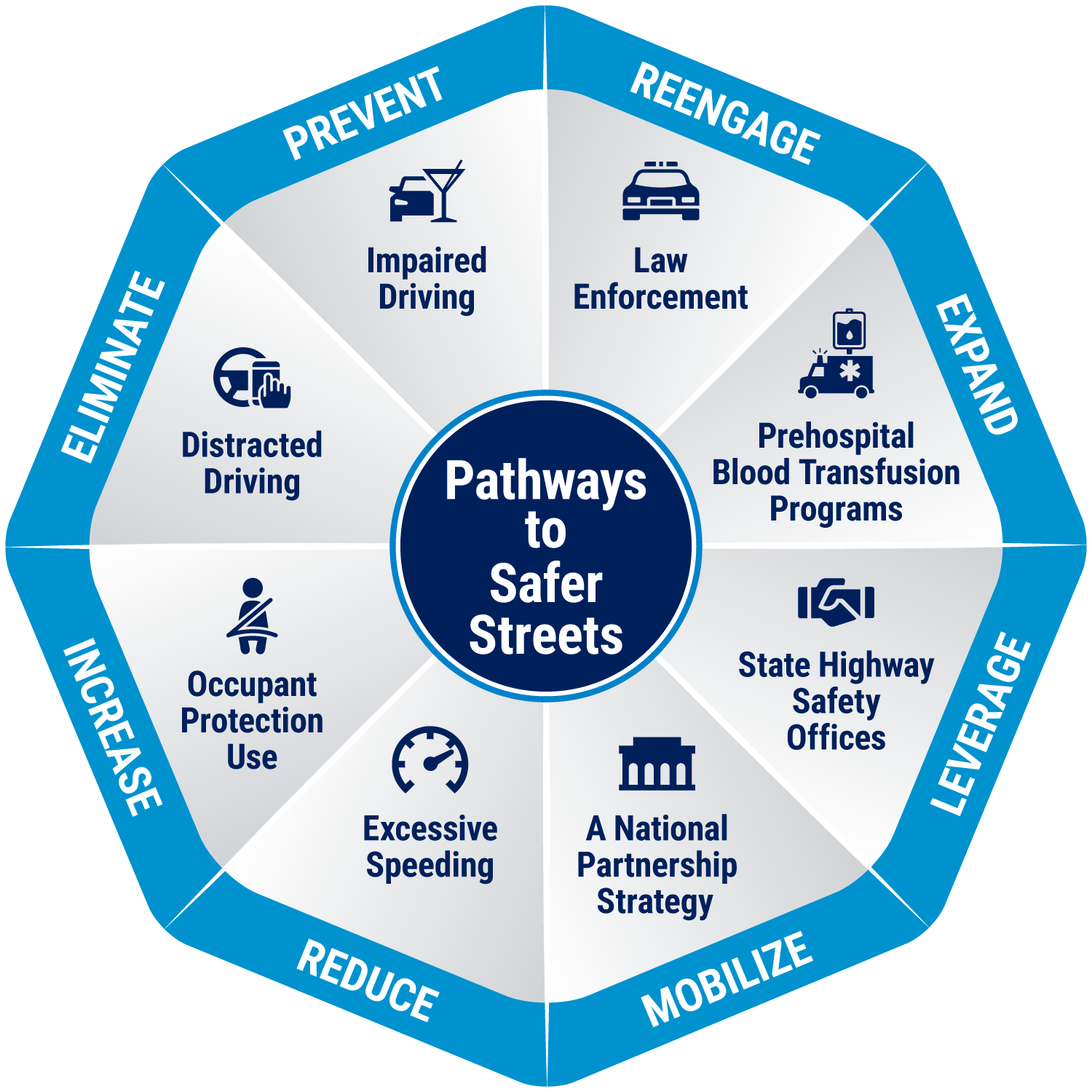
The data is clear: Despite hard-won progress, the roadway safety crisis is still a significant behavioral problem in the United States. At NHTSA, we aim to drastically reduce injuries and fatalities through the eight core pathways listed below. These actions form the foundation of our plan to reengage law enforcement, curtail risky driving behaviors, strengthen emergency response, and rebuild a culture of safety and responsibility that will save lives on America’s roads.

Reengage Law Enforcement
Did You Know? Data-driven high visibility enforcement deters and interrupts illegal and dangerous driving behaviors – ultimately promoting voluntary compliance with traffic laws. When law enforcement is present, people choose safer actions.
NHTSA in Action: A cornerstone of this strategy is renewed engagement with law enforcement. NHTSA will revitalize partnerships with law enforcement to increase traffic enforcement, restoring the “deterrence effect” that has weakened since the pandemic. This pathway will restore and enhance grants and partnerships, create new public service awards for exemplary traffic enforcement, and increase training for prosecutors and judges to ensure unsafe drivers face consequences.
Milestones
- Announced an investment of $20 million through the Innovative Traffic Safety Enforcement (ITSE) program to develop, test, and validate next-generation safety technology and analytics in local communities.
- Revitalized federal backing for the Data-Driven Approaches to Crime and Traffic Safety (DDACTS) initiative, helping departments place scarce patrol resources exactly where crime and crashes intersect.
 Reduce Excessive Speeding
Did You Know? Speeding contributes to 30% of all roadway fatalities every year. High speeds are especially dangerous for pedestrians, cyclists and other road users outside a vehicle.
NHTSA in Action: NHTSA will promote the smart use of technology to augment traditional law enforcement. Using technology as a force-multiplier prevents overextending law enforcement resources while ensuring consistent data-driven enforcement in high-risk zones.
Milestones
- Kicked off "Speeding Catches Up With You" campaign at Nashville Superspeedway, focused on speed prevention and encouraging high-visibility enforcement.
 Prevent Impaired Driving
Did You Know? Impaired driving contributes to more than a third of all roadway fatalities every year. Of drivers arrested or convicted for DWI, 25% are repeat offenders.
NHTSA in Action: NHTSA will focus on support for innovative approaches to increased prosecution, specialized legal support, and implementation of technologies that help reduce impaired driving recidivism. The agency will improve state data systems to track offenders from arrest through adjudication and improve collaboration.
Milestones
- Expanded the regional toxicology liaison program to all 50 states and Washington, D.C., to standardize drug-testing protocols and reduce processing delays.
- Published the Impaired Driving Tracking System Readiness Guide to assist states in closing information gaps by linking arrests directly to court outcomes and treatment.
- Piloted the Military Judicial Impaired Driving course and published an official Oral Fluid case study report to help combat drug-impaired driving.
 Leverage State Highway Safety Offices
Did You Know? Reducing roadway fatalities requires analysis of state and local crash data, and the application of effective countermeasures.
NHTSA in Action: NHTSA will provide SHSOs with an AI-powered State Program Hub that offers 24/7 access to real-time data insights by visualizing trends and hotspots, helping identify priority safety issues and tailored countermeasures to support informed decision making.
Milestones
- Finished the first 14 Data Deep Dives, providing SHSOs with powerful custom dashboards mapping local crash, census, and EMS data.
- Successfully launched the Promising Practices Repository, a tool sharing successful local safety projects, backed by an introductory showcase webinar.
- Conducted a comprehensive workshop during Lifesavers where participants engaged in shared learning on data analysis, operational planning, and grant writing, while exploring the integration of AI to enhance decision-making.
- Conducted targeted highway safety analyses for military bases in California, Virginia, and Florida, delivering high-impact visual briefings to military leadership to build organizational goodwill and establish an entry point for future collaboration with State Highway Safety Offices.
 Expand Prehospital Blood Transfusion Programs
Did You Know? Nationally, 43% of people killed in crashes between 2019 and 2023 were alive when first responders arrived on the scene. One of the most promising innovations in post-crash care is prehospital blood transfusion, which research shows decreases mortality among trauma patients with severe bleeding by 37%.
NHTSA in Action: NHTSA is funding the expansion of prehospital blood transfusion programs across the country. The agency will issue an EMS Guide that identifies countermeasures to prevent crash fatalities and mitigate injuries.
Milestones
- Field programs administering prehospital blood transfusions grew exponentially from 100 to over 350 programs in just two years.
- Secured $30 million via an interagency agreement with the Department of War's Uniformed Services University to establish 25 operational demonstration projects. Additionally, $50 million was awarded through the Safe Streets and Roads for All (SS4A) grant program to fund field transfusion equipment.
 Mobilize a National Partnership Strategy
Did You Know? Roadway safety and reducing injuries and fatalities requires partnership at the federal, state, and local levels.
NHTSA in Action: NHTSA will strategically partner with agencies and organizations with national, state, and local audiences to amplify the agency’s messaging and promote connections with SHSOs. This will move public education beyond traditional media to community-level engagement.
Follow on LinkedIn and Traffic Safety Marketing for more updates.
Milestones
- Developed outreach materials for select target audiences (Military, Tribal, and other Federal Partners) identified through increased partnership work.
- Promoted SHSO partnerships through Traffic Safety Opportunity Sheets.
- Collaborated with FHWA and ROUTES to host a Rural Peer Exchange in Kansas City, MO. It brought together safety, infrastructure, EMS, transit, and law enforcement stakeholders from 8 states to share data-driven best practices and strategies for addressing rural road safety challenges.
- Developed the Tribal Safety Support Plan, establishing a unified, NHTSA-wide framework to support Tribal Nations through dedicated safety programming, enhanced data collection, and technical assistance.
 Increase Occupant Protection Use
Did You Know? Nearly half of fatalities are unrestrained occupants. More than half (56%) of those killed during the night were unrestrained.
NHTSA in Action: NHTSA is funding nighttime enforcement: operations during hours when belt use typically drops. Additionally, we will support states in adopting tougher primary seat belt laws and child passenger safety requirements.
Milestones
- Published the "Rural High Five" Seat Belt Program Demonstration and Evaluation Report and How-to Guide to combat low daytime and nighttime seat belt usage in rural areas.
- Published and distributed Bridging Cultures to Buckle Up: A Guide for Working with Tribes to Increase Seat Belt Use. These resources are designed for State and local officials, as well as non-governmental organizations and advocates, who are interested in partnering with Tribes in their areas to improve traffic safety through targeted occupant protection initiatives, specifically increasing seat belt use.
 Reduce Distracted Driving
Did You Know? Distracted driving is underreported, due to the difficulties of capturing real-world data.
NHTSA in Action: We will research innovative ways to identify the full scope of distracted driving and reflect how modern drivers use in-vehicle and other technology on the road. We will gather promising practices from states to prevent distracted driving and publish information on how partial driving automation affects driver distraction.
Milestones
- Kicked off Distracted Driving Awareness Month with the "Put the Phone Away or Pay" campaign. Notably, the national safety campaign marked the first time in history that a transportation secretary served as the face of a NHTSA safety advertisement.