


What to Know: Deadly Air Bag Replacements
Certain air bag inflators have caused deaths and injuries in the United States
Overview
There is an urgent warning for anyone driving a vehicle that has previously been involved in a crash where air bags deployed. Replacement air bags installed in vehicles are responsible for numerous deaths and injuries.
The Latest
NHTSA issued a final decision that frontal driver air bag inflators marked with the identifier "DTN60DB" contain a defect related to motor vehicle safety. NHTSA concluded that these air bag inflators not only fail to protect vehicle occupants during a crash but pose a direct risk of death or serious injury.
Eleven people have died and three others were severely injured in 14 crashes where the vehicle involved had an air bag replaced with these inflators that were likely illegally imported into the United States. These fatalities occurred in crashes that should have been survivable.
The Problem
Air bag inflators marked with the identifier "DTN60DB" were likely illegally imported and have been found installed in American vehicles.
Most of the vehicles involved were in a crash and had their original equipment air bags replaced with air bag modules containing these air bag inflators. Air bags may have been replaced for other reasons, including theft. After the air bags were replaced and the vehicle was involved in a crash, the air bag inflators malfunctioned and ruptured, sending large metal fragments into drivers’ chests, necks, eyes and faces, leading to death or severe injury.
Who Is Potentially at Risk and What to Do?
You must review the vehicle’s history report to look for:
- Air bag deployment history.
- Previous crashes or “total loss” events.
- Reported theft history.
- Repairs performed at non-certified service centers.
If your vehicle has any of the above, have it inspected by a certified technician at the vehicle manufacturer’s dealership or a reputable independent mechanic. They can review NHTSA’s technician guidance and verify if the inflator is genuine replacement equipment.
If a DTN60DB inflator is found, the vehicle should not be driven until you are able to have it replaced with genuine original equipment parts. Do not attempt to inspect the vehicle yourself – tampering with the steering wheel or air bag could result in a deployment causing death or serious injury.
How to Report Suspect Parts
If your vehicle has a DTN60DB inflator, you should report it to the following authorities:
- Law Enforcement: Contact your local Homeland Security Investigations office, FBI field office, or the National Intellectual Property Rights Coordination Center.
- NHTSA: Submit a complaint online or call NHTSA’s Vehicle Safety Hotline at
888-327-4236 (Monday to Friday, 8 a.m. to 8 p.m. ET).
NHTSA has alerted the auto repair industry to be on the lookout for these dangerous inflators and to notify NHTSA immediately with any additional information they may have about these inflators.
Frequently Asked Questions
While NHTSA’s order requires the manufacturer of these inflators to initiate a recall, because these inflators were likely illegally imported and a list of affected vehicles is not available, a traditional recall is unlikely. NHTSA’s final decision makes it illegal for anyone to import or sell these defective inflators in the United States. NHTSA will work with our law enforcement partners to hold all responsible parties accountable.
This final decision means NHTSA has determined that these inflators have a safety-related defect and has banned the importation and sale of these defective inflators.
If you have bought or are considering buying a used car, you should obtain a vehicle history report. While NHTSA does not endorse any specific services, air bag deployment history can be found free using vehicle history information available through third-party providers such as CARFAX.com/airbags. Enter your VIN or license plate, then search. CARFAX will show for free whether the vehicle had a reported air bag deployment. If the vehicle has been in a previous crash with an air bag deployment, you should have the vehicle inspected to determine if any of these inflators were used in the replacement. A reputable mechanic or dealership can review NHTSA’s technician guidance and inspect your vehicle to determine if it has one of these air bags. Only an inspection can determine if your vehicle is affected.
The air bag inflators were likely illegally imported into the United States. These air bag modules were then installed as replacement parts, generally after an air bag deployed in a previous crash or was stolen from the vehicle.
NHTSA is aware of the following crashes.
| Date | Location | Vehicle | Injury |
|---|---|---|---|
| May 30, 2023 | Dallas, TX | 2018 Chevrolet Malibu | Fatal |
| June 11, 2023 | Sarasota, FL | 2020 Chevrolet Malibu | Fatal |
| Sept 4, 2023 | Philadelphia, PA | 2021 Chevrolet Malibu | Severe Injuries |
| Oct 25, 2023 | Fort Worth, TX | 2020 Chevrolet Malibu | Severe Injuries |
| Mar 1, 2024 | Oklahoma City, OK | 2022 Chevrolet Malibu | Fatal |
| Feb 3, 2025 | Phoenix, AZ | 2017 Hyundai Sonata | Fatal |
| July 30, 2025 | West Valley City, UT | 2019 Hyundai Sonata | Fatal |
| Sep 26, 2025 | Hayward, CA | 2020 Chevrolet Malibu | Fatal |
| Oct 31, 2025 | Wichita, KS | 2018 Chevrolet Malibu | Fatal |
| Dec 16, 2025 | Austin, TX | 2018 Hyundai Sonata | Fatal |
| Dec 16, 2025 | Toledo, OH | 2019 Chevrolet Malibu | Fatal |
| Feb 16, 2026 | Clarksdale, MS | 2020 Chevrolet Malibu | Fatal |
| June 16, 2026 | Louisville, KY | 2020 Chevrolet Malibu | Severe Injuries |
| Aug 27, 2026 | Dallas, TX | 2018 Chevrolet Equinox | Fatal |
Although so far NHTSA is only aware of ruptures involving these inflators installed as aftermarket equipment in Chevrolet Malibu, Hyundai Sonata or Chevrolet Equinox vehicles, there is no information indicating the problem is limited to those vehicles.
The inflators are labeled with “DTN,” which is the abbreviated name of Chinese air bag inflator manufacturer Jilin Province Detiannuo Safety Technology Co. Ltd., a Chinese manufacturer of air bag inflators. The company filed a response to the agency arguing that they have not sold inflators to the United States for installation in vehicles, and that the inflators may be counterfeit versions of their inflators. Regardless of manufacturer, these inflators are dangerous and defective.
If you know for certain that your vehicle has never been in a crash or had its air bags replaced under unknown circumstances, this issue does not affect you. If you haven’t done so already, you should obtain a vehicle history report to help verify the crash history.
These air bag inflators are aftermarket equipment not tied to your vehicle’s VIN. A VIN search cannot tell you if your vehicle has one. The “What to Do” section on this page has more information.
A dealership for the vehicle manufacturer or a reputable, trustworthy independent repair shop can review NHTSA’s technician guidance and do this inspection for you.
These inflators are etched or labeled with the identifier "DTN60DB.” A technician conducting an air bag inspection may be able to identify it using a label on the electrical connector side containing the number sequence “144415654 666631” or “144415654 666633.” An inspection should only be done by a reputable mechanic – do not attempt to remove the air bag cover or inspect it yourself.
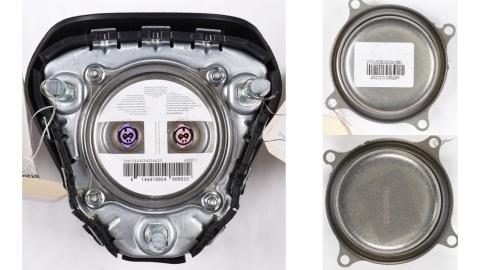
An inflator installed in an air bag module and labeled with a distinctive number sequence and bar code.
You would need to pay for the inspection.
You would be responsible for paying for the replacement. If your vehicle has one of these inflators, you should not drive it until you are able to have it replaced. These inflators have caused multiple fatalities, and it is imperative that they be identified, removed and replaced.
No, under no circumstances should you attempt to inspect the air bag yourself or dismantle any part of your steering wheel. People have been killed while attempting to work on their own air bags.
No, the replacement Takata air bags were genuine replacement parts and are not affected by this issue.